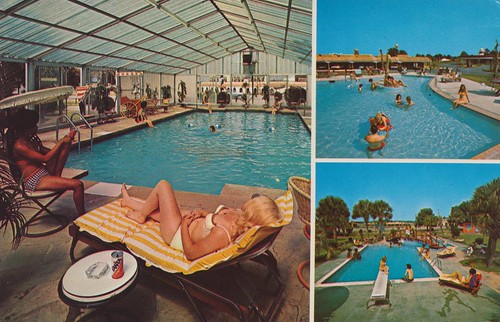
Two unknown belly dancers at the Eden Roc Hotel in Miami Beach, Florida sometime in 1958.
Tuesday, April 26, 2011
Wednesday, April 20, 2011
The Redwood House - Los Angeles, California
This is a menu from the Redwood House in Los Angeles, California. Not sure of the date of this menu. I am guessing it's 40s or 50s.
Saturday, April 16, 2011
Thursday, April 14, 2011
Atlantic City Speedway - Pleasantville, New Jersey
This is an undated brochure (but I think it's from 1964) for the upcoming Auto Race season at the Atlantic City Speedway on W. Washington Ave. in Pleasantville, New Jersey.
The Speedway was built int 1950 and lasted until 1979. I found a little bit of information from EHT.com:
The EHT Speedway was located on Washington Avenue, Egg Harbor Township, but it was called the Atlantic City Speedway or the Pleasantville Speedway because back then EHT did not have its own identity. We were always considered part of someone else's town. Usually we were called the town name that was closest to what ever the attraction was, hence the name Pleasantville Speedway.
From 1950 to 1979 and for only $1.25 Southern New Jersey race fans, kids and local residents could go to the races every Saturday night and have a great time rooting for their favorite driver. Food and souvenirs were available. After the races many drivers would pose for photos with their cars, and if you were lucky you might be allowed to climb into one of the race cars.
Cars would roar past the stands (on the left) and around the track. Some of the stock cars (as they were called back then) were sponsored but many of the cars were owned by the men who drove them. They would work on their car all week during the evenings, then race on Saturday night and hope they didn't crash or do anything that would cost money to repair.
The Speedway was built int 1950 and lasted until 1979. I found a little bit of information from EHT.com:
The EHT Speedway was located on Washington Avenue, Egg Harbor Township, but it was called the Atlantic City Speedway or the Pleasantville Speedway because back then EHT did not have its own identity. We were always considered part of someone else's town. Usually we were called the town name that was closest to what ever the attraction was, hence the name Pleasantville Speedway.
From 1950 to 1979 and for only $1.25 Southern New Jersey race fans, kids and local residents could go to the races every Saturday night and have a great time rooting for their favorite driver. Food and souvenirs were available. After the races many drivers would pose for photos with their cars, and if you were lucky you might be allowed to climb into one of the race cars.
Cars would roar past the stands (on the left) and around the track. Some of the stock cars (as they were called back then) were sponsored but many of the cars were owned by the men who drove them. They would work on their car all week during the evenings, then race on Saturday night and hope they didn't crash or do anything that would cost money to repair.
Monday, April 11, 2011
Motel Monday: Seeing Red
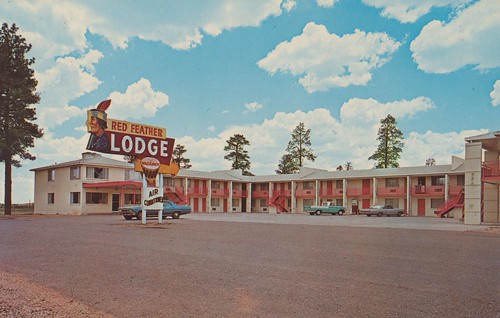
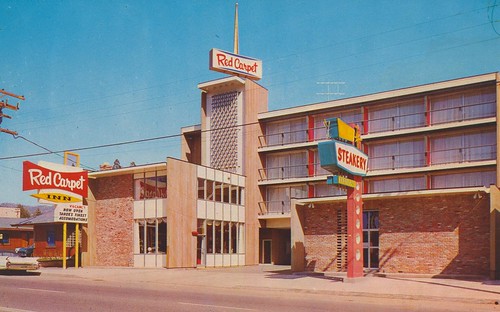
This week's Motel Monday theme is motels with "Red" in the title somewhere. There's a variety of things from American Indians, fruit, horses, arrows, and shingles that can only be described as red.
All postcards from my collection. You can see my other blog, In The Heart of Downtown, to see my entire posted collection of over 2,500 different motels.
![]() |
| Red Feather Lodge - Grand Canyon, Arizona |
![]() |
| Red Apple Motel - Yakima, Washington |
![]() |
| Red Carpet Inn - Stateline, California |
Labels:
Arizona,
California,
Colorado,
Maryland,
Montana,
Motel,
North Carolina,
Ohio,
Utah,
Vermont,
Washington,
Wyoming
Saturday, April 9, 2011
Wednesday, April 6, 2011
Ball-Band Red Ball - March & April 1963
Ball-Band was a rubber plant located in Mishawaka, Indiana. Here's a brief history of the company from the Center For History site:
In 1867 Jacob Beiger puchased a small wooden mill built in 1838 near the dam and Mishawaka Woolen Manufacturing Company was born. Incorporated in 1874, the company produced red flannel boots. Adolphus Eberhart and Martin Beiger invented All Knit Boots in 1886. They were made with a black band around the top and when a red ball was later added the Ball Band trademark resulted.
Stakes were driven for the first rubber-making plant in 1897. In 1899 the company was authorized to build a new four-story warehouse. More improvements were added after 1900 because of an increase in sales. After Martin Beiger’s death in 1903, a 30-man syndicate took control of the company. Later, Mishawaka Woolen Company became a subsidiary of U.S. Rubber.
In 1921 a five-story storage and warehouse building designed by Albert Kahn was erected. The name of the company was changed to Mishawaka Rubber and Woolen Manufacturing Company in 1923, and to Uniroyal, Inc. in 1967. All footwear manufactured by Mishawaka Rubber Company was discontinued in 1969, and, due largely to the price pressures from foreign competition, Mishawaka Rubber Company was dissolved. Uniroyal closed after filing bankruptcy on April 1, 1997. All the buildings were demolished/imploded a few years later. Today, the site is home to the C. Beutter Riverfront Park
This is the March & April 1963 issue featuring articles on government, predictions for 1963 and the use of new-fangled walkie-talkies in the factory.
In 1867 Jacob Beiger puchased a small wooden mill built in 1838 near the dam and Mishawaka Woolen Manufacturing Company was born. Incorporated in 1874, the company produced red flannel boots. Adolphus Eberhart and Martin Beiger invented All Knit Boots in 1886. They were made with a black band around the top and when a red ball was later added the Ball Band trademark resulted.
Stakes were driven for the first rubber-making plant in 1897. In 1899 the company was authorized to build a new four-story warehouse. More improvements were added after 1900 because of an increase in sales. After Martin Beiger’s death in 1903, a 30-man syndicate took control of the company. Later, Mishawaka Woolen Company became a subsidiary of U.S. Rubber.
In 1921 a five-story storage and warehouse building designed by Albert Kahn was erected. The name of the company was changed to Mishawaka Rubber and Woolen Manufacturing Company in 1923, and to Uniroyal, Inc. in 1967. All footwear manufactured by Mishawaka Rubber Company was discontinued in 1969, and, due largely to the price pressures from foreign competition, Mishawaka Rubber Company was dissolved. Uniroyal closed after filing bankruptcy on April 1, 1997. All the buildings were demolished/imploded a few years later. Today, the site is home to the C. Beutter Riverfront Park
This is the March & April 1963 issue featuring articles on government, predictions for 1963 and the use of new-fangled walkie-talkies in the factory.
Monday, April 4, 2011
Motel Monday: Come Sea About Me
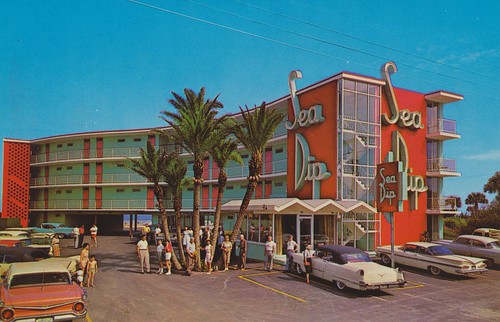
This week's Motel Monday features motels with the word "Sea" in the title. A lot of these names make sense for the location, but some are just way off. I am pretty sure there aren't many sea shell in Lordsburg, New Mexico or sea breezes in Phoenix.
All the postcards are from my collection. You can see my entire (posted) collection of nearly 2,500 different motels at In the Heart of Downtown.
![]() |
| Sea Dip Motel and Apartments - Daytona Beach, Florida |
![]() |
| The Sea Horse - Daytona Beach, Florida |
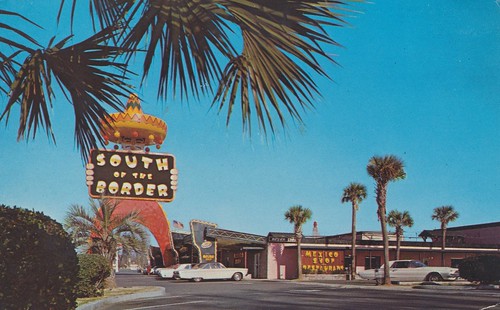
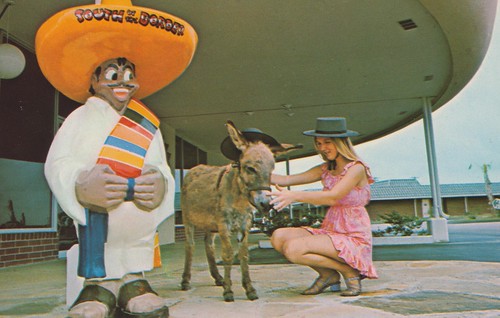
South of the Border, South Carolina
I had a heck of a time trying to describe South of the Border so I am going to let the all "knowing" Wikipedia describe it for me:
South of the Border is a rest stop and roadside attraction on Interstate 95 and U.S. Highway 301/501 between Dillon, South Carolina and Rowland, North Carolina. It is named "south of the border" being south of the U.S. state of North Carolina. The rest area features not only restaurants, gas stations and a motel, but also a small amusement park, shopping (including, formerly, adult entertainment at the "Dirty Old Man Shop"), and, famously, fireworks. Its mascot is Pedro, an extravagantly stereotypical Mexican bandido. It is advertised by hundreds of billboards along surrounding highways, starting 175 miles away. Well-known landmarks in the area, the irreverent signs feature Pedro, wearing an oversized sombrero and poncho, counting down the number of miles to, and promoting, South of the Border.
This is my current collection of South of the Border postcards. Clicking on the images will lead you back to my flick account with descriptions of each image.
South of the Border is a rest stop and roadside attraction on Interstate 95 and U.S. Highway 301/501 between Dillon, South Carolina and Rowland, North Carolina. It is named "south of the border" being south of the U.S. state of North Carolina. The rest area features not only restaurants, gas stations and a motel, but also a small amusement park, shopping (including, formerly, adult entertainment at the "Dirty Old Man Shop"), and, famously, fireworks. Its mascot is Pedro, an extravagantly stereotypical Mexican bandido. It is advertised by hundreds of billboards along surrounding highways, starting 175 miles away. Well-known landmarks in the area, the irreverent signs feature Pedro, wearing an oversized sombrero and poncho, counting down the number of miles to, and promoting, South of the Border.
This is my current collection of South of the Border postcards. Clicking on the images will lead you back to my flick account with descriptions of each image.
Subscribe to:
Posts (Atom)