
During the depression, the Stevens family (which included a young son named John Paul Stevens who went on to become a Justice in the Supreme Court) went bankrupt and was ultimately charged with financial corruption. The government took over the hotel. Then, in 1942, the United States Army purchased the Stevens for $6 million and turned it into classrooms and barracks for use during the second World War. There were over 10,000 cadets housed in the Stevens and the once famous Grand Ballroom was turned into their eating quarters/mess hall. The War Department ultimately sold the Stevens to a businessman named Stephen Healy in 1944.
Conrad Hilton purchased the hotel from Hotel in 1945. The name of the hotel was changed to the Conrad Hilton in 1951. Hilton redesigned and added to the building throughout the years.
In 1968, during the Democratic National Convention, the streets outside the hotel were the scene to the riots that took place between Major Richard J. Daley's police officers and anti-Vietnam protesters. During the chaos the hotel was overtaken by protesters that lobbed stink bombs and tear gas into the lobby.
In 1984, the hotel was closed for what was then the most expensive hotel renovation of all time. The cost was $185 million. The Conrad Hilton was closed for more than a year. During the renovation, the 3,000 guest rooms became 1,544 bigger and nicer rooms.The newly renamed Chicago Hilton and Towers was reopened on October 1, 1985. In 1998, the name was shortened to Hilton Chicago.
These postcards are not meant to be the complete history of the hotel. These are the ones currently in my collection. The writing under each card is the description and the mailed message (if there was one).
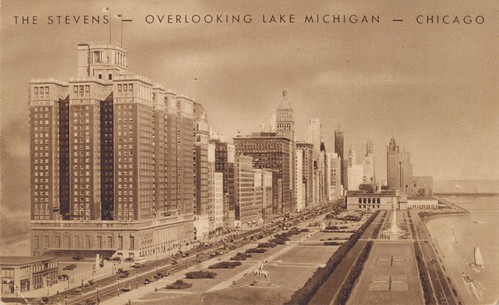
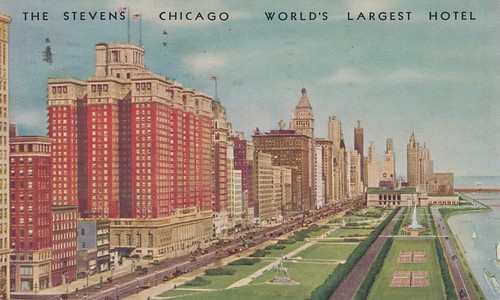
Located in the very heart of the city on Chicago's famous Michigan Boulevard overlooking Grant Park and the LAKE. The Stevens occupies Chicago's finest hotel location preferred by vacation, pleasure, business travelers.
Mailed from Chicago, Illinois to Mr. Thos. Weddle of Wichita, Kansas on February 22, 1939:
Dear Tom & Stella,
The convention is over except dist. agents meeting tomorrow. We are O.K. Will be home Fri. if the roads are good. Has been snowing but is not cold. H.O.

Mailed from Old P.O. Annex 2 in Chicago, Illinois to Mr. & Mrs. Paul Hineryman of Jonesboro, Illinois on July 31, 1942:
Dear Sis & Bro -
Just a line to let you know my new address, Hope this finds you OK. Will write later.
Love, Artie

Exhibition rooms for conventions containing over 35,000 square feet.
Note on the back:
Virgil Scaggs. I was in the Stevens hotel Saturday night April 1, 1944.

Chicago, Illinois
Located on Michigan Boulevard at 7th Street opposite Grant Park, and overlooking Lake Michigan, THE STEVENS is conveniently near Chicago's Loop - but away from the noise of the downtown district. 3,000 delightful, outside rooms of the Famous BOULEVARD ROOM which features fine cuisine, dancing to famous orchestras, and a full hour music comedy revue, starring the BOULEVAR-DEARS.
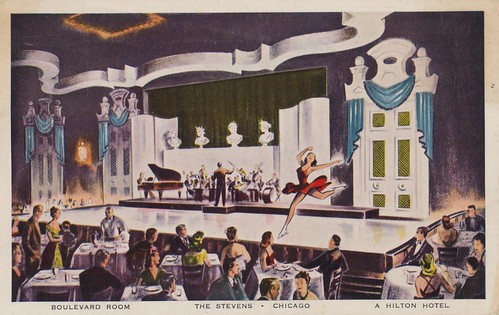
The outstanding night spot in Chicago...featuring lavish Ice Shows on the largest hotel ice rink in the country...big cast of skating stars. Finest cuisine and famous orchestras for dancing.
THE STEVENS - Chicago - A Hilton Hotel
Mailed from Chicago, Illinois to Anna L. Petrarsu of Warwick, Rhode Island on February 16, 1949:
This is one the restaurants in the hotel - Mama & Daddy


No comments:
Post a Comment